
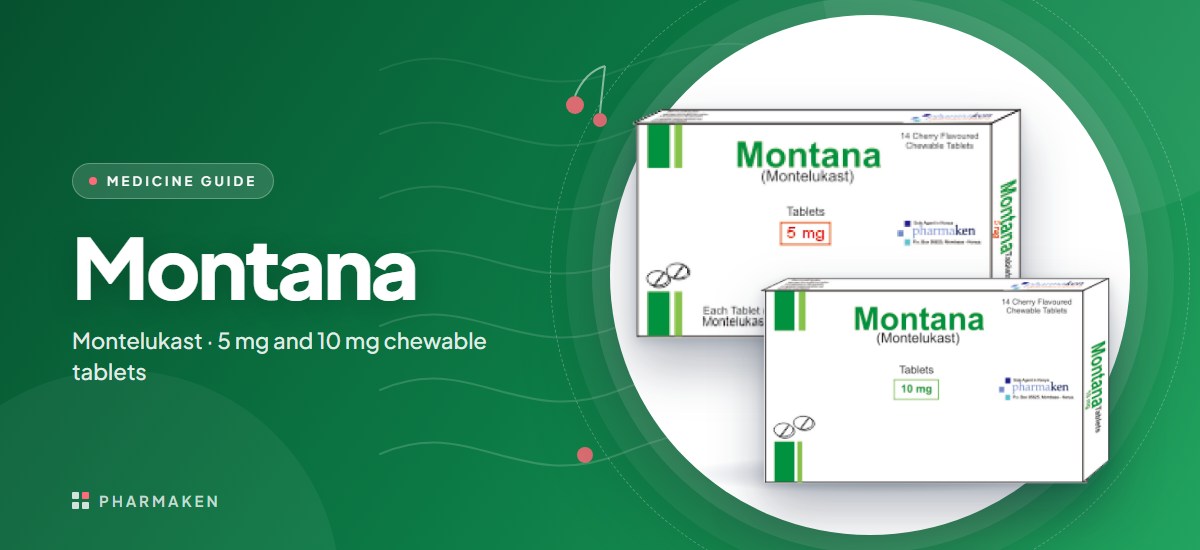
Asthma is the most common chronic disease of childhood, and allergic rhinitis often travels with it. Montana montelukast offers an oral, once-daily option for both conditions. Montelukast is a leukotriene receptor antagonist (LTRA). Pharmaken supplies Montana as 5 mg chewable tablets for children aged 6 to 14 years and 10 mg tablets for adolescents and adults. This guide explains how montelukast works, where it fits in asthma care, how to dose it and which safety warnings to discuss with families.

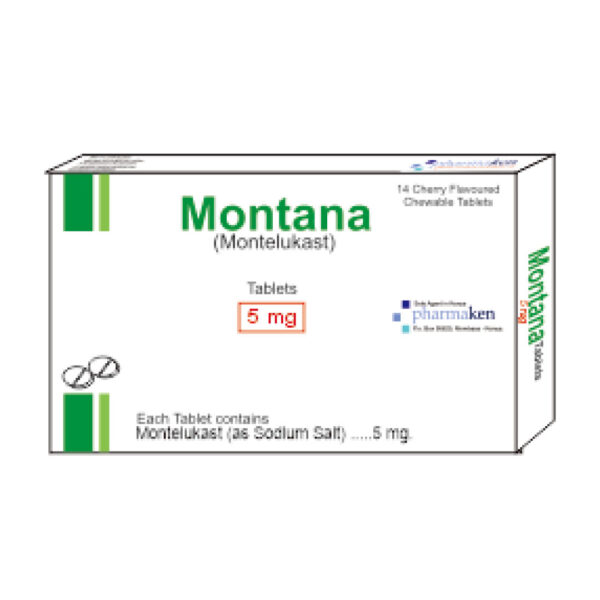
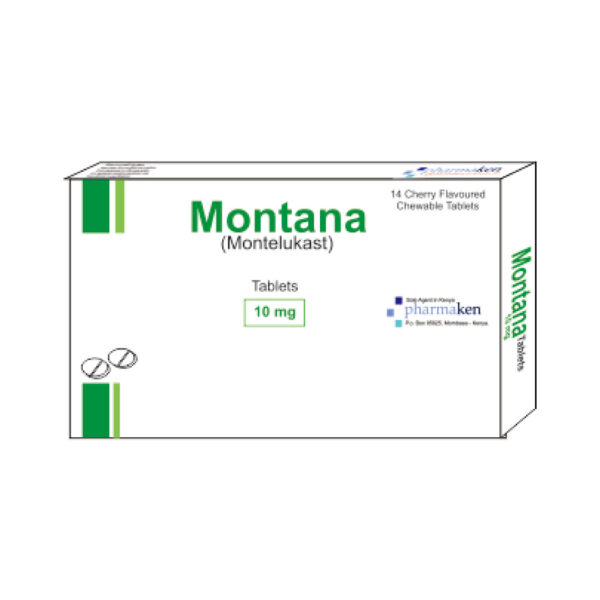
Available from Pharmaken: Montana 5mg Chewable Tablets, Montana 10mg Chewable Tablets.
What is Montana (montelukast)?
Montana contains montelukast sodium, a selective antagonist of the cysteinyl leukotriene type 1 (CysLT1) receptor. It is available as:
- Montana 5 mg chewable tablets, for children aged 6 to 14 years;
- Montana 10 mg tablets, for adolescents aged 15 years and over and for adults.
Montelukast is well absorbed and has a half-life of about three to six hours. Even so, its clinical effect lasts 24 hours, which allows once-daily dosing.
How Montana montelukast works
In allergic airways, mast cells and eosinophils release inflammatory chemicals called cysteinyl leukotrienes (LTC4, LTD4 and LTE4). These leukotrienes bind CysLT1 receptors in the airways and nose. As a result, they cause:
- bronchoconstriction, which narrows the airways;
- mucus production and swelling of the airway lining;
- recruitment of eosinophils, which sustains inflammation;
- nasal congestion in allergic rhinitis.
Montelukast blocks CysLT1 receptors, so these effects decrease. Consequently, it reduces airway inflammation and protects against triggers such as allergens and exercise. However, its anti-inflammatory effect in asthma is generally weaker than that of inhaled corticosteroids.
What is Montana used for?
Montana montelukast is indicated for:
- Persistent asthma, as add-on therapy when inhaled corticosteroids and reliever inhalers do not give adequate control;
- Alternative controller therapy for mild persistent asthma in patients who cannot use inhaled corticosteroids;
- Exercise-induced bronchoconstriction, as prevention;
- Allergic rhinitis, seasonal or perennial, especially in patients who also have asthma.
Asthma affects hundreds of millions of people worldwide, according to the World Health Organization. Many deaths occur in low- and middle-income countries, where inhaler access and technique are often poor. Therefore, an oral controller can help in selected patients, although inhaled corticosteroids remain the foundation of treatment.
Dosage and administration
- Children 6 to 14 years: one Montana 5 mg chewable tablet once daily.
- Adolescents 15 years and older, and adults: one Montana 10 mg tablet once daily.
- Children 2 to 5 years: 4 mg once daily is the usual dose, which needs a different product.
For asthma, give the dose in the evening. For allergic rhinitis, the timing can follow the patient’s preference. For exercise-induced bronchoconstriction, take a dose at least two hours before exercise, and do not take a second dose within 24 hours. The chewable tablet should be chewed before swallowing. It can be taken with or without food, although the 5 mg chewable tablet is best taken one hour before or two hours after food.
Montelukast does not relieve an acute asthma attack. Patients must always carry their reliever inhaler, such as salbutamol.
Contraindications
- hypersensitivity to montelukast or any excipient.
Warnings and precautions
- Neuropsychiatric events: regulators, including the US FDA, require a boxed warning. Reports include agitation, aggression, sleep disturbance, vivid dreams, anxiety, depression and, rarely, suicidal thoughts. These events can occur in children and adults. Therefore, discuss this risk before prescribing, and ask families to report mood or behaviour changes promptly.
- Allergic rhinitis alone: because of the neuropsychiatric risk, reserve montelukast for patients who respond poorly to or cannot use other allergy treatments.
- Not for acute attacks: montelukast has no role in treating acute bronchospasm.
- Do not replace inhaled steroids abruptly: withdraw them only under medical supervision.
- Eosinophilic conditions: rarely, patients develop eosinophilic granulomatosis with polyangiitis, often when oral steroids are reduced.
- Phenylketonuria: chewable tablets contain aspartame, a source of phenylalanine.
Side effects
- headache, which is usually mild;
- abdominal pain, nausea or diarrhoea, especially in the first days;
- upper respiratory infections;
- sleep disturbance or nightmares;
- irritability or mood changes;
- raised liver enzymes, which is uncommon.
Drug interactions
- Enzyme inducers such as phenobarbital, phenytoin and rifampicin lower montelukast levels. Monitor the clinical response.
- Montelukast does not interact significantly with theophylline, warfarin, digoxin or oral contraceptives.
Pregnancy and breastfeeding
Observational data have not shown a clear increase in birth defects. Accordingly, Montana montelukast can be used in pregnancy when clinically needed, especially for patients who were well controlled on it before pregnancy. Uncontrolled asthma poses a greater risk to mother and baby. Montelukast passes into breast milk in small amounts, so use it only if clearly needed.
Counselling points for families
- Give the tablet at the same time every evening, even when the child is well.
- Keep using inhaled steroids and the reliever inhaler as prescribed.
- Watch for changes in sleep, mood or behaviour, and report them promptly.
- Also, avoid known triggers, such as smoke, dust and cold air, where possible.
- Have an asthma action plan, and know when to seek emergency care.
Storage
Store Montana below 30 °C in the original blister, protected from light and moisture. Keep it out of the reach of children.
Where Montana montelukast fits in asthma care
The Global Initiative for Asthma (GINA) now recommends that adults and adolescents use an inhaled corticosteroid-containing inhaler, even for mild asthma. Therefore, montelukast is mainly an add-on or an alternative, not a first choice. For example, it helps when a child cannot use an inhaler reliably, or when exercise-induced symptoms persist despite inhaled treatment. In addition, it can benefit patients who also have allergic rhinitis. However, before adding any drug, check inhaler technique and adherence first, because they are the most common reasons for poor control. Finally, review the response after four to eight weeks, and stop montelukast if it adds little.
For healthcare professionals and facilities: request a quotation or product samples through the Pharmaken healthcare portal, or contact our Mombasa and Nairobi teams for product information.
Frequently asked questions
Can Montana replace an asthma inhaler?
No. Inhaled corticosteroids remain the most effective controllers, and every patient needs a reliever inhaler. Montelukast is mainly an add-on or alternative.
How quickly does Montana montelukast work?
It starts working on the first day, but the full benefit may take one to two weeks.
Can a child chew the 10 mg tablet?
No. Children aged 6 to 14 years should use the 5 mg chewable tablet.
Key takeaways
- Montana montelukast is a once-daily leukotriene receptor antagonist in 5 mg and 10 mg strengths.
- It helps control asthma, prevents exercise-induced bronchoconstriction and relieves allergic rhinitis.
- It does not treat acute attacks, and it does not replace inhaled steroids.
- Discuss the neuropsychiatric warning, and ask families to report mood or sleep changes.
References and further reading
- World Health Organization: Asthma fact sheet
- Approved product information for Montana 5mg Chewable Tablets, Montana 10mg Chewable Tablets (Pharmaken Ltd); always consult the package insert.
Important: This article is educational information for healthcare professionals. It does not replace the approved product information, clinical guidelines or professional judgement. Dosing must be individualised by the prescriber. Report suspected adverse drug reactions or poor-quality medicines to the Pharmacy and Poisons Board through pv.pharmacyboardkenya.org.